Pharmacokinetics study how the body acts on the drug, in terms of speed and concentration (ADME)
- Invasion:
- Liberation: Release of the drug from its pharmaceutical formulation
- Generally merged with Absorption
- Absorption: Entry of the drug to the blood stream
- Distribution: From the blood stream to the other compartments
- Liberation: Release of the drug from its pharmaceutical formulation
- Elimination:
- Metabolism: Transformation / Alteration of the drug
- Excretion: Exit of the drug and its metabolites
Pharmacodynamics study how the drug acts on the body = The desired and adverse effects the drug has on the body
To have an effect, a drug needs to act on a target:
- Non-specific physical interaction:
- Osmosis: Attract water and accumulate water on one side of a membrane
- Antacids: Bases that neutralize the acids
- Magnesium hydroxide Mg(OH)2
- Chelators: Bind and sequester metallic ions to form a complex
- Biochemical interaction:
- Inhibition of enzymes:
- NSAIDs (Meloxicam): Inhibition of Cyclooxygenase 2 (COX-2)
- Inhibition of Inflammatory cascade
- ACE Inhibitors (Benazepril): Inhibition of Angiotensine Convertase Enzyme (ACE)
- Inhibition of Renin Angiotensine System
- Decrease of blood pressure
- Inhibition of Renin Angiotensine System
- AChE inhibitors (Diazinon): Inhibition of Acetylcholine Esterase (AChE)
- Accumulation of Acetylcholine in the synaptic cleft
- Parasympathomimetics effects
- Accumulation of Acetylcholine in the synaptic cleft
- Proton Pump Inhibitors (Omeprazol): Inhibition of the H+/K+ ATPase pump of stomach’s parietal cells
- Decreased acid release in the stomach
- Increase of pH in the stomach
- Decreased acid release in the stomach
- NSAIDs (Meloxicam): Inhibition of Cyclooxygenase 2 (COX-2)
- Alteration of DNA:
- Action on transporters:
- Inhibition of ion channels:
- Action on receptor proteins:
- Ligand-gated ion channels
- Nicotinic Acetylcholine Receptor nAChr
- Ligand: Acetylcholine
- Action: Lets Na+ flow IC > Depolarization
- Found in:
- Neuromuscular junction
- Made of different subunits than the CNS and ANS: Allows for binding of Curare (Peripheral Muscle Relaxants)
- Autonomous Nervous System Ganglia
- Central Nervous System
- Neuromuscular junction
- GABAa Receptor
- Ligand: Gamma Amino Butyric Acid GABA
- Action: Lets Cl- flow IC > Hyperpolarisation
- Has multiple binding sites:
- GABA site: For GABAa Agonists
- Orthosteric binding: Binding on the site made for the ligand (GABA)
- Benzodiazepines (BDZ) site
- Allosteric binding: Binding on another site than the one made for the ligand (GABA)
- Propofol is very effective because it acts on both sites
- Both Allosteric and Orthosteric binding
- GABA site: For GABAa Agonists
- Nicotinic Acetylcholine Receptor nAChr
- G protein coupled receptors: Made of 7 transmembrane domains
- Gαs: Stimulating effect
- β-Adrenoreceptor (Sympathomimetics)
- Ligand: Epinephrine
- β-Adrenoreceptor (Sympathomimetics)
- Gαi: Inhibitory effect
- M2 Muscarinic Acetylcholine Receptors mAChr (Parasympathomimetics)
- α2 Receptors (α2 Agonists)
- Gq: Excitatory effect
- α1 Receptors (Alpha Agonists)
- H1 Histamine Receptors
- Serotonin Receptors
- Gαs: Stimulating effect
- Receptor-activated Tyrosine Kinases
- Insulin Receptor
- Just Another Kinase JAK Receptors (Inhibited by JAK Inhibitors)
- Involved in Immune reactions
- Intracellular Nuclear Receptors:
- Generally lipophilic to pass through the plasma and nuclear membranes
- Glucocorticoids Receptors
- The activated nuclear receptor releases HSP90 Heat Shock Proteins to enter the nucleus
- Ligand-gated ion channels
- Inhibition of enzymes:
Important terms:
- Ligand: The molecule which binds with a receptor in its binding site
- Binding is usually reversible
- Binding allows for change of conformation of the receptor to activate it
- Strength of binding (Affinity) is defined by the dissociation constant Kd
- Kd: Constant of dissociation
- Kd = Ratio of Rate of dissociation / Rate of association
- High Kd = Likely to dissociate a lot > Poor affinity
- Low Kd = Likely to associate (Bind) a lot > Good affinity
- Kd = Ratio of Rate of dissociation / Rate of association
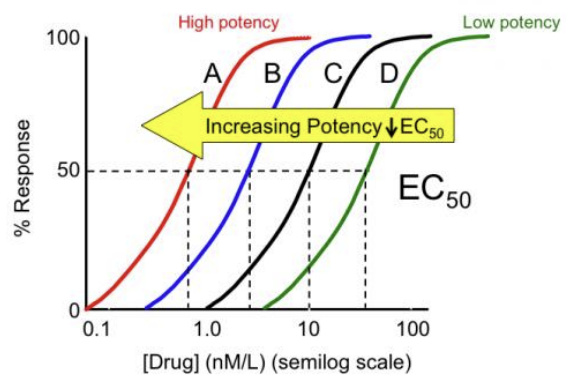
- EC50: Half Maximum Effective Concentration
- The concentration of drug required to have an effect 50% as strong as the maximum effect the drug can reach
- Potency: Capacity of a drug to start acting from a low concentration
- A higher potency is characterized by:
- A lower minimum concentration for the drug to have an effect
- A dose-response curve shifted to the left
- A lower EC50
- A higher potency is characterized by:
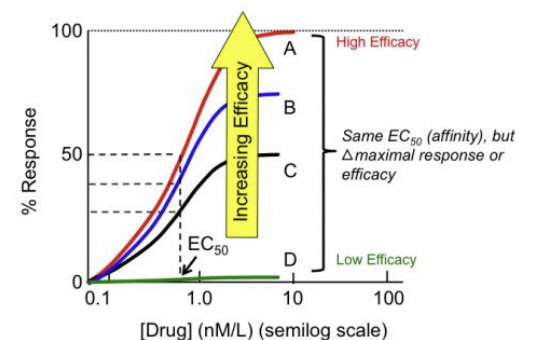
- Efficacy: Capacity of a drug to elicit a strong effect on the body
- A higher efficacy is characterized by:
- A higher maximum effect achievable with the drug
- A dose-response curve shifted upwards
- No link to the EC50 value
- A higher efficacy is characterized by:
- Types of effects:
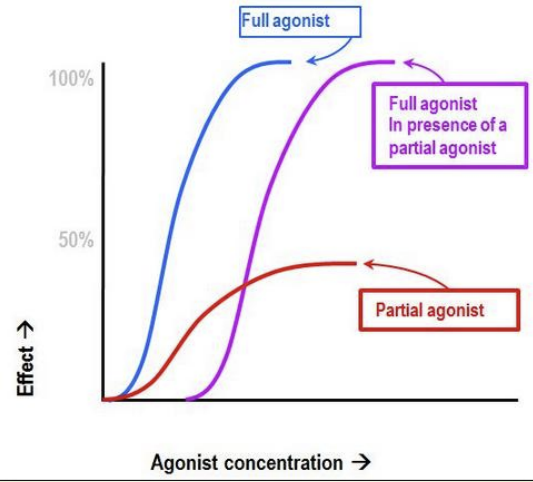
- Full agonist: Elicits a maximal response > Strong effect
- Partial agonist: Elicits a submaximal response > Mild effect
- Antagonist:
- Classification on target:
- Receptor antagonist
- Orthosteric binding: On the active binding site
- Reversible binding: Competitive antagonist
- Virtually reduces the potency of the agonist
- The agonist has to fight its own dissociation rate and the association rate of the antagonist to act > Decreased potency
- Virtually reduces the potency of the agonist
- Irreversible binding: Noncompetitive active site antagonist
- Reversible binding: Competitive antagonist
- Allosteric binding: On another site
- Reversible / Irreversible: Noncompetitive Allosteric antagonist
- Non-receptor antagonist:
- Chemical antagonist: Opposite chemical activity
- Physiologic antagonist: Opposite action on a physiological system (Doesn’t necessarily acts on the same molecular target)
- Orthosteric binding: On the active binding site
- Receptor antagonist
- Classification on action:
- Full antagonist: Inhibits the generation of a response > Blocks the effects (Neutral antagonist)
- Inverse agonist: Elicits the opposite response (Often referred as Antagonist)
- Classification on target:
- Occupancy model:
- Two drugs binding a same receptor are competing against each other = The drug that binds the receptor prevents the binding of the other drugs, thus preventing its action
- Competitive antagonist: Binds the receptor first and prevents the binding of the agonist: Prevents generation of a response
- Partial agonist: Binds the receptor and elicits a submaximal response, prevents the binding of the Full agonist which would have elicited a maximal response
- The efficacy is higher than the Partial agonist’s alone, but lower than the Full agonist’s alone
- Buprenorphine and Butorphanol are Opioids Receptor Partial agonists, they can be used to mitigate the effects (Especially the adverse cardiac and respiratory depression effects) of Full agonists such as Morphine and Fentanyl
- They are a better choice as Antidote than the Full antagonist Naloxone which would completely remove the effects (Including the desired antalgic effects) during the surgery and cause extreme pain
- Two drugs binding a same receptor are competing against each other = The drug that binds the receptor prevents the binding of the other drugs, thus preventing its action
- Quantal dose-response curves:
- Integral curve of all the dose-response curves of all the individuals of the population
- ED50: Median Effective Dose
- The concentration of drug that produces the therapeutic effect in 50% of the population
- TD50: Median Toxic Dose
- The concentration of drug that causes toxic adverse effect in 50% of the population
- LD50: Median Lethal Dose
- The concentration of drug that kills 50% of the population
- TI: Therapeutic Index
- TI = Ratio of LD50 (or TD50) over ED50
- High TI = Safe
- The lethal or toxic dose is quite high compared to the therapeutic dose = Low risks of overdosing
- Low TI = Dangerous
- The lethal or toxic dose is close to the therapeutic dose = High risks of overdosing
- Ex: Remifentanil, Morphine, Digoxin, Atropine, Ethanol
- High TI = Safe
- TI = Ratio of LD50 (or TD50) over ED50
- MEC: Minimum Effective Concentration MEC
- Lowest concentration that has a therapeutic effect
- MTC: Maximum Tolerated Concentration
- Highest therapeutic concentration before having toxic adverse effects
- Therapeutic Window:
- Range of concentration between the MEC and MTC
- In increasing concentration: No effects < MEC < Therapeutic window < MTC < Toxic effects (Overdose)
- Specificity: A highly specific drug has only a few targets
- Lokivetmab Only targets IL-31
- Selectivity: A highly selective drug has the majority of its effects on its target
- β2 Agonists (Sympathomimetics) by increasing selectivity of β2 over β1 receptors: Clenbuterol (4:1) < Salbutamol (650:1) < Salmeterol (50 000:1)
- Low selectivity causes Off-target side effects
- Beta blockers (Sympatholytics): Are used to decrease the Heart’s β1 effects (Antiarrhythmic Drugs)
- Those which lack selectivity for β1 cause blocking of β2 receptors of the lungs and bronchospasm (Off-target side effects)
- Ivermectin targets the parasite’s GABA receptors
- In some dog breeds with a mutated MDR-1 gene (Collies, Australian shepherds), the P-Glycoprotein of the Blood Brain Barrier is defective and Ivermectin can have off-target side effects in the Dog’s brain
- Beta blockers (Sympatholytics): Are used to decrease the Heart’s β1 effects (Antiarrhythmic Drugs)
Effects depend on:
- The ligand:
- Its dose
- Its pharmacokinetics properties
- How much of the given dose make it to the target receptor
- Individual differences
- Sensitivity: Ivermectin in MDR-1 mutated Dogs
- The receptor:
- How much it is expressed
- The tissues it is expressed in
- Nicotinic Acetylcholine Receptor in different tissues:
- Neuromuscular Junction
- Autonomous Nervous System ganglia
- Central Nervous System
- Nicotinic Acetylcholine Receptor in different tissues:
- The nature of its response
- Epinephrine receptors have different types of response:
- α Receptors: Constriction
- β Receptors: Dilation
- Epinephrine receptors have different types of response:
Types of adverse effects:
- Toxic metabolites: Paracetamol is metabolized by Dogs into hepatotoxic NAPQI
- Harmful immunological effects:
- Immunologically mediated: Cause an anaphylactic reaction
- Anti-Allergy MAB such as Bedinvetmab cause anaphylactic reactions if used in the wrong species
- Some animals are allergic to Penicillins or Sulfonamides
- Non immunologically mediated: Doesn’t activate the immune system through its physiological mechanisms, but it elicits a response
- ex: Degranulation of Histamine due to high Morphine dose
- Immunologically mediated: Cause an anaphylactic reaction
Cellular regulation of drug-receptor interactions:
- Drug tolerance:
- Pharmacodynamics tolerance (Desensitization):
- Continuous binding of agonists on the receptors lead to sequestration of the receptors and downregulation of the signal
- Ex: Opioids receptors
- Continuous binding of agonists on the receptors lead to sequestration of the receptors and downregulation of the signal
- Pharmacokinetic tolerance:
- Induction of CYP450 enzymes increase the metabolism of the drugs > Quicker elimination > Downregulation
- Ex: Phenobarbital, Ethanol
- Induction of CYP450 enzymes increase the metabolism of the drugs > Quicker elimination > Downregulation
- Pharmacodynamics tolerance (Desensitization):
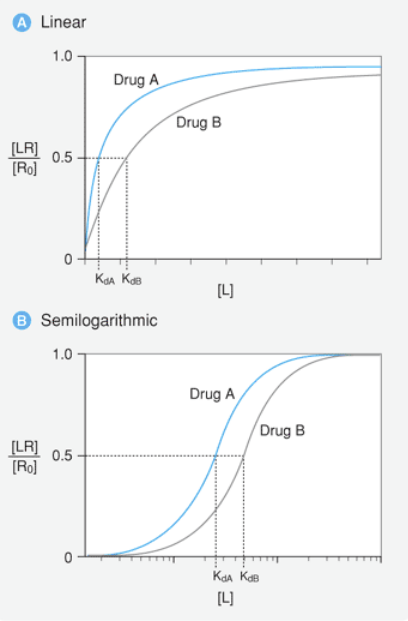
Drug A has a higher proportion of receptor binding (Ligand - Receptor LR) than Drug B, therefore its Kd is lower than Drug B’s
Occupancy model
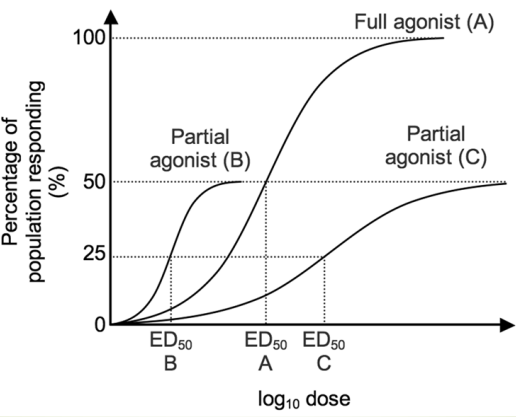
Potency: B > A > C
Efficacy: A > B = C