Pharmacokinetics Pharmacokinetics Modelling
Steady State Level:
- Constant plasma concentration of the drug achieved after multiple repeated administrations
- To reach a mean a Concentration in Plasma at Steady State Cpss
- We aim to have a Cpss in the Therapeutic Window to keep a constant therapeutic concentration
- Cpss = (1.44 x Dose x F x t1/2) / (Vd x τ)
- F = Bioavailability (Pharmacokinetics of Absorption)
- t1/2 = Half life of the drug = hl (Pharmacokinetics Modelling)
- Vd = Apparent volume of distribution (Pharmacokinetics of Distribution)
- τ = Dosing interval = Time between 2 administrations
- 5 x t1/2 = Five half lives rule: Time required to reach the Steady State Concentration Cpss (To reach 97% of Cpss) (Pharmacokinetics Modelling)
- If we want to increase the dosing interval τ (Ex: We double it) for convenience (Need to administer the drug less often to the animal > Less hassle): We have to double the given dose to keep the same Cpss
- Cpss = (1.44 x Dose x 2 x t1/2) = (Vd x τ x 2) = (1.44 x Dose x F x t1/2) / (Vd x τ)
- If we want to decrease each administration’s dose (Ex: We halve it) to have less fluctuation of the concentration , we decrease the dosing interval (So we increase the frequency of administration)
- Cpss (1.44 x Dose x 0.5 x t1/2) = (Vd x τ x 0.5) = (1.44 x Dose x F x t1/2) / (Vd x τ)
- Loading dose:
- To reach Cpss faster than by giving 5 identical doses at a τ interval
- Allows for a faster therapeutic effect
- We give an initial high dose Bolus to reach a plasma concentration close to the target Cpss
- Then we give normal maintenance doses to keep the plasma concentration at the target Cpss
- Loading Dose = Target Cpss x Vd
- To reach Cpss faster than by giving 5 identical doses at a τ interval
- Maintenance Dose:
- Normal dose to keep the plasma concentration at the target Cpss
- Can be given as Constant Rate Infusion CRI or repeated small Bolluses
- The administration rate needs to be equal to the elimination rate to keep the equilibrium: Ra = Rel
- Ra = Re = Target Cpss x Clearance Cl b = Target Cpss x Cl x β x Vd
- Cl b = β x Vd
- t1/2 = ln(2) x Vd / Cl
- Normal dose to keep the plasma concentration at the target Cpss
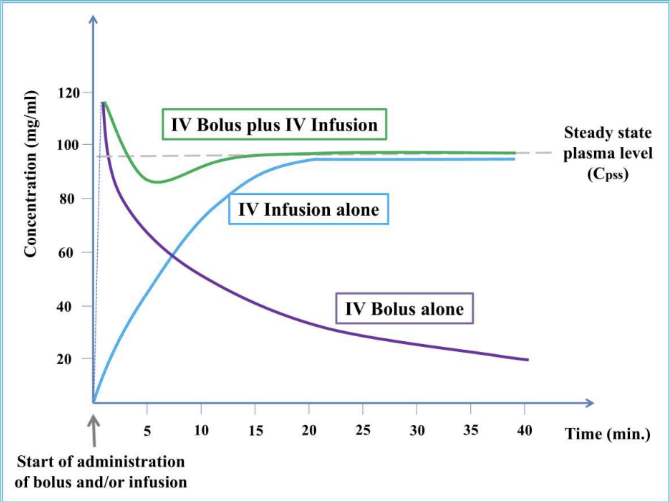
Green curve: The loading dose (IV Bolus) allows to reach the target Cpss quickly, the maintenance dose (IV Infusion) allow to to keep the plasma concentration at this level
Pharmacokinetics/Pharmacodynamics PK/PD Hybrid Modelling:
- EC50: Half Maximum Effective Concentration
- The concentration of drug required to have an effect 50% as strong as the maximum effect the drug can reach
- ED50: Median Effective Dose (Pharmacokinetics)
- The concentration of drug that produces the therapeutic effect in 50% of the population
- ED50 = Cl x EC50 / Bioavailability
- PK/PD modelling is essential to maximize the therapeutic effects and minimizing the toxic effects as there is generally a delay between the changes in concentrations and the effects they cause
- Triangular analysis involves:
- Body: Interacting with
- Medicine: Pharmacokinetics ADME kinetics
- Pathogen: Causing inflammation and tissue damage
- Medicine: Interacting with
- Body: Pharmacokinetics ADME kinetics
- Pathogen: Pharmacodynamic effects on the pathogen
- Pathogen: Interacting with
- Body: Inflicting inflammation and tissue damage in the body
- Medicine: Resisting and/or developing resistance against the drug
- Body: Interacting with
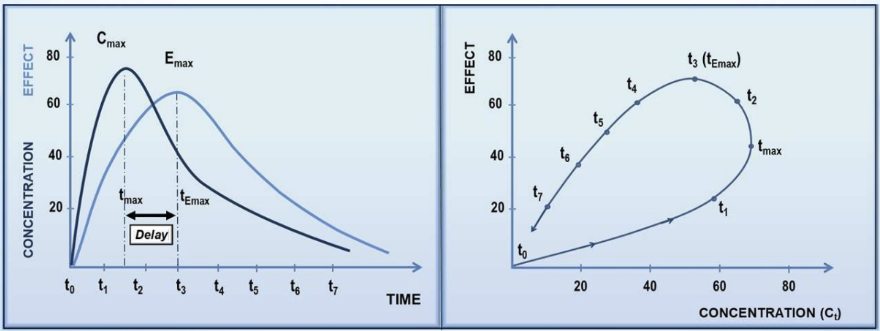
Left graph: Shows the delay between changes in concentration and the observed effects they cause
Right graph: Shows that the effects increase between t1 and t3 despite the concentration remaining almost identical because of the lag between the rise in concentration and the effects
Factors influencing drug efficacy:
- Pharmacodynamics:
- Pharmacokinetics:
- Absorption: Pharmacokinetics of Absorption
- Penicillins can destroy the gut flora, it is contraindicated in Herbivores and Rodents for which microbial fermentation play an important role in digestion
- Ampicillin (Penicillins): Not good for PO administration in Horses, this Antibiotics kills the good GI bacterial flora and favorizes E. coli proliferation
- Penicillins can destroy the gut flora, it is contraindicated in Herbivores and Rodents for which microbial fermentation play an important role in digestion
- Distribution: Pharmacokinetics of Distribution
- Ivermectin is lethal for mutated MDR-1 Dogs (Such as Collies) as it can cross the BBB and cause toxic effects in the brain
- Protein binding: Can cause Drug-drug interactions
- Metabolism: Pharmacokinetics of Metabolism
- NSAIDs: Salicylates and Phenols can form metabolites toxic for Cats
- Sulfonamides: Different metabolism between species
- Acetylation: Mostly in cats, forms poorly soluble metabolites > Crystalluria
- Glucuronide conjugation: Mostly in dogs and humans, forms soluble metabolites > No crystalluria
- Propofol and Thiopental are metabolized by CYP2B11 which is less active in Greyhounds > Longer t1/2
- They are more lean Dogs: Less fat > Less redistribution from the fat tissues
- Procaine is degraded by Procainase enzyme which is lacking in Piglets > Sensitive for Procaine and Benzylpenicillin-Procaine- (Narrow Spectrum Penicillins)
- Atropine: Rabbits and Goats are not sensitive because they are used to eat plants containing Atropine, a low dose would kill a Horse
- Excretion: Pharmacokinetics of Excretion
- Urine pH: Ion trap
- At low urine pH: Basic drugs are less reabsorbed (Because they are) protonated and ionized > More excreted
- At high urine pH: Acidic drugs are less reabsorbed (Because they are) deprotonated and ionized > More excreted
- Urine pH: Ion trap
- Interspecies differences:
- Mydriasis: Dilated pupils
- Mammals: Caused by antagonizing the Muscarinic Acetylcholine Receptor mAChr: with Atropine
- Birds, Reptile, Amphibians: Caused by antagonizing the Nicotinic Acetylcholine Receptor nAChr: with D-Tubocurarine
- Loop Diuretics:
- Mammals: Full action
- Birds: Limited action because only 1/3 nephrons have a Loop of Henle
- Reptiles, Fish, Amphibians: No action due to missing Loop of Henle
- Mydriasis: Dilated pupils
- Health status:
- Fever: Reduced emptying of stomach > Decreased absorption (Decreased Bioavailability F)
- Diarrhea: Increased gut motility > Decreased time spent in the small intestine > Decreased F + Exsiccation > Alteration of distribution and excretion
- Poor body condition (Ex: Cachexia): Altered distribution
- Dose dependent effects:
- Atropine: Antimuscarinic (Parasympatholytics) < Pre-Anesthetic < Antidote for Organophosphates
- Xylasine: Weak sedation + Mild analgesia < Deep sedation + Strong analgesia
- Route of application:
- Magnesium Sulfate MgSO4:
- PO: Laxatives
- IV: Anesthetics and Euthanasia
- Magnesium Sulfate MgSO4:
- Feeding:
- Ca2+ rich feed can decrease the PO F of Tetracyclines
- Metabolic enzymes’ activity can be increased by certain plant steroids > Influence the metabolism of drugs
- Sex:
- Males: Have more Testosterone which is a CYP3A inductor > Can enhance the metabolism of certain drugs
- Absorption: Pharmacokinetics of Absorption
Factors influencing drug action:
- Tolerance: Building up of resistance against a drug
- Tachyphylaxis: Rapid development of drug tolerance
- Drug immunity: Total absence of sensitivity for a drug from birth (Ab ovo), not acquired during life
- Dependance:
- Habituation: Psychological need to take a drug built from a habit
- Addiction: Psychological and frequently Physiological need to take a drug
- Idiosyncrasy:
- Individual out of the norm response to a drug
- Hypersensitivity Immune Reactions:
- Can be life threatening
- Rare adverse reaction
- Generally doesn’t happen on first application, but much more likely to occur on the following applications
- Anaphylaxis (Allergy):
- Concerns Type I Hypersensitivity reactions: Immunoglobulins E IgE mediated
- Anaphylactoid Reactions (Pseudo Allergy):
- Concerns Type II - IV Hypersensitivity reactions: Not mediated by Immunoglobulins E IgE
- Less frequent than Anaphylactic reactions